The Indian side also told the Chinese delegation that the talks on disengagement should include Depsang as well as all face-off sites, insisting that it should be a simultaneous process and not a selective one.
The two sides have already held at least 12 rounds of talks between local commanders and three rounds of talks between major general-rank officials but no positive outcome came out from the discussions, they said.

The use of firearms along the LAC marks a serious escalation in border tensions as the previous instance of shots being fired at the de-facto border was in 1975.

This was the first round of talks for Wang after he succeeded State Councillor Yang Jiechi earlier this year.
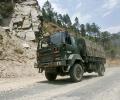
It is learnt that Defence Minister Rajnath Singh has conveyed to top military brass that there was no need for reviewing the implementation of any of the key projects along the Line of Actual Control (LAC) in Ladakh, Sikkim, Uttarakhand or in Arunachal Pradesh in view of the aggressive behaviour by Chinese troops in several sensitive areas.

The Indian Army has been matching up to the Chinese build up in both Pangong Tso lake and Galwan Valley, the two locations in Ladakh which have witnessed major reinforcement of troops in the last two weeks, sources said. There was very little chance of easing of tension anytime soon as both sides are aggressively holding onto their respective positions, they said.

Prime Minister Narendra Modi's visit to Arunachal Pradesh on Friday, February 20, irritated the Chinese government so much that it summoned the Indian ambassador to register its protest against Modi visiting a territory China claims as Southern Tibet.
The decision to disengage the forces, locked in a bitter standoff for the last six weeks in eastern Ladakh, was taken at a nearly 11-hour-long meeting between senior Indian and Chinese commanders in Moldo on the Chinese side of the Line of Actual Control (LAC) on Monday.

India and China decided to seek a fair and rational solution to their border dispute on Saturday as they focused on the proposed border defence cooperation agreement to avert incursions like the one witnessed in Leh region last month.
India's envoy had said that stand-off in Doklam saying it happened because Beijing tried to alter the "status quo" which it should not have.

The government has adopted a multi-pronged approach involving the Army, the Indian Air Force and the Navy as well as diplomacy and economic measures to send out a firm and clear message to China that its misadventure in eastern Ladakh was not acceptable at all.
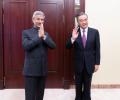
The effort made to define the larger picture by focussing on history and the wish not turn differences into disputes and conflicts is welcome. In the obtaining circumstances today, nothing more could have been possible, observes Ambassador T P Sreenivasan.
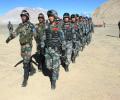
Indian and Chinese troops remained engaged in an eyeball-to-eyeball situation in several disputed areas.
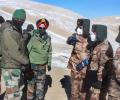
Foreign Secretary Harsh Vardhan Shringla terms India's relationship with China as "complex".

The Wednesday talks took place amid a war of words between the two sides on perception of the LAC, the de-facto Sino-India border spanning a length of nearly 3,500 km.
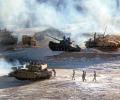
'India cannot allow Beijing's policy of stabilising and destabilising the border at will to perpetuate its own ends.' A riveting excerpt from Manish Tiwari's 10 Flashpoints; 20 Years National Security Situations That Impacted India.

He also said it was important that even during the difficult moments of this "crisis" India has been communicating and engaging with China.
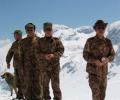
The PLA said the move has 'seriously damaged' border peace and tranquillity.

'By causing military humiliation of India it intends to send a signal to other Asian countries to toe the Chinese line,' argues Colonel Anil A Athale (retd).

Easy availability of drones has increased the complexity of security challenges and the Indian military is developing capabilities to effectively deal with the threats, be it from State-sponsored elements or by states themselves, Army Chief Gen M M Naravane said on Thursday.
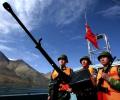
The Chinese side has particularly bolstered its presence in the Galwan Valley, erecting around 100 tents in the last two weeks and bringing in heavy equipment for construction of bunkers, notwithstanding the stiff protest by Indian troops. There have been reports of multiple incidents of transgressions by Chinese troops in several areas in Eastern Ladakh.

It is the first highest level face-to-face meeting between the two sides after the border row escalated in eastern Ladakh in early May.

A simultaneous announcement about the meeting was made from New Delhi and Islamabad on Wednesday after Foreign Secretary Sujatha Singh and her Pakistani counterpart Aizaz Ahmad Chaudhry had a telephonic conversation.
People familiar with the situation in the region said the two sides were engaged in trying to resolve the dispute, but there was no indication of a positive outcome yet as both the armies continued to bolster their positions in disputed areas of Pangong Tso and Galwan Valley and Demchok.

'The government will ensure that India's pride is not affected as far as the situation along Indo-China border is concerned'
Indian military sources said no firearms were used in the clashes and that most of the injuries were sustained following stone-pelting and use of rods by the Chinese side.

Amid a spate of incursions by China in Ladakh, its troops are also resorting to tactics like preventing the Indian army from patrolling posts in this sector along the border, which is well within India's territory.

India and China are trying to develop effective mechanisms to prevent the "embarrassing" face-offs between their troops along the "disputed" points of the Line of Actual Control, Defence Minister A K Antony said in New Delhi on Friday.

'The potential of one such LAC engagement going out of control and leading to heavy casualties cannot be ruled out,' warns Lieutenant General Syed Ata Hasnain (retd).
India has maintained there is no scope for a third party mediation.

He stressed the need for strengthening mutual trust and confidence while seeking solutions to outstanding issues.
The decisions were mentioned in a joint statement issued by the two armies late Tuesday, a day after the sixth round of Sino-India Corps commander-level talks that lasted for 14-hours.
Responding to a question on the meeting between Pakistan Prime Minister Imran Khan and United States President Donald Trump in the US, Rawat said that Pakistan can do anything to get money.

Four Chinese soldiers were killed in the fierce clash with the Indian Army in the Galwan Valley in eastern Ladakh in June last year, the People's Liberation Army (PLA) acknowledged for the first time on Friday.

Besides the border question, India and China discussed issues related to counterterrorism including Beijing's blocking of India's bid in the United Nations to ban Pakistan-based JeM chief Masood Azhar, National Security Advisor Ajit Doval said on Thursday.
Most of India's reserves for war in the mountains have been sucked in by the standoff with China. A large part of India's airpower has also similarly been committed on the eastern border. By moving these reserves to the China border, India has been weakened vis-a-vis Pakistan. All in all, the nightmare scenario for India of a two-front war may well come true, warns Colonel Anil A Athale (retd).

'Does the Indian army's new assertiveness risk a clash escalating into shooting and possibly skirmishes?' asks Ajai Shukla.

China on Tuesday said border talks with India have yielded "initial results", enabling the two neighbours to properly handle their differences over the vexed boundary issue and maintain peace along the frontier.
He called for delineation of the 3,488-km Line of Actual Control (LAC) which China has refused earlier.

The prime minister and the Chinese president walked along the banks of East Lake and also took a boat ride together as they decided to step up their personal rapport.
